Carbon Reduction Plan
Supplier name: Peregrine International Limited
Publication date: 14/04/2026
Commitment to Achieving Net Zero
Peregrine is committed to achieving Net Zero emissions by 2050 in line with UK Government PPN 06/21 requirements. Given that the majority of emissions arise from our supply chain as well as employee commuting and homeworking, our reduction pathway will prioritise these areas to ensure meaningful and achievable emissions reductions.
Baseline Emissions Footprint
Baseline emissions are a record of the greenhouse gases that have been produced in the past and were produced prior to the introduction of any strategies to reduce emissions. Baseline emissions are the reference point against which our emissions reduction can be measured.
Baseline Year: 2024
Additional Details relating to the Baseline Emissions calculations. Peregrine’s baseline emissions were quantified for the reporting period 2024. Business carbon emissions have been quantified and a business carbon emissions inventory created. Significant emission sources have been identified and highlighted. Our baseline emission calculations have been prepared in accordance with the methodology of BS EN ISO 14064-1:2019; Quantification and reporting of greenhouse gas emissions and removal with guidance from the Greenhouse Gas Protocol and SECR guidelines.
The assessment quantification adheres to the Department for Environment, Food and Rural Affairs (DEFRA) guidance on quantifying and reporting greenhouse gas emissions. This assessment provides a baseline inventory against which carbon reduction achievements can be measured, monitored and reported. The quantification and analysis provided facilitates the setting of a strategic target for carbon reduction, identification of areas of focus for carbon reduction efforts and facilitates monitoring of progress towards those targets.
Emissions TOTAL (tCO2e)
Scope 1: 0.00
Scope 2: 0.00
Scope 3: (Included Sources): 715.39
(Purchased Goods and Services, Transportation and Distribution (Upstream and Downstream), Waste, Business Travel, Employee Commuting and Homeworking, Upstream Leased Assets)
Total Emissions: 715.39
Peregrine’s baseline emissions have been calculated in accordance with BS EN ISO
14064-1:2019, the Greenhouse Gas Protocol, and SECR guidelines
Current Year Emissions Reporting
Reporting Year: 2025
Emissions TOTAL (tCO2e)
Scope 1: 0.00
Scope 2: 0.00
Scope 3: (Included Sources) 547.34
(Purchased Goods and Services, Transportation and Distribution (Upstream and Downstream), Waste, Business Travel, Employee Commuting and Homeworking, Upstream Leased Assets)
Total Emissions: 547.34
Emissions Reduction Targets
Peregrine is committed to achieving Net Zero emissions by 2050.
In 2025 we achieved a 23.5% reduction in absolute emissions against our 2024 baseline, putting us ahead of our reduction pathway. Building on this progress, we have adopted the following updated carbon reduction targets:
● Reduce total GHG emissions by 40% by 2030, relative to the 2024 baseline of 715.39 tCO₂e (target: 429 tCO₂e)
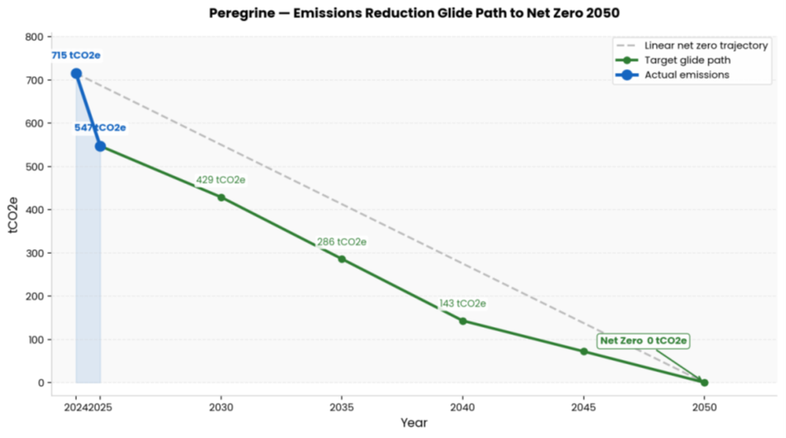
In 2025, Peregrine’s total GHG emissions were 547.34 tCO₂e, a reduction of 23.5% from the 2024 baseline of 715.39 tCO₂e, driven by streamlined business operations and reduced expenditure. We project that emissions will continue to decrease over the coming years, targeting approximately 429 tCO₂e by 2030 (40% reduction from baseline), 286 tCO₂e by 2035 (60% reduction), 143 tCO₂e by 2040 (80% reduction), and Net Zero by 2050. The glide path below illustrates the required reduction trajectory.
As this is our first Carbon Reduction Plan, there are no existing carbon emission reduction targets against which to report progress. In the future we plan to implement further measures that will continue to drive down emissions, some of which are listed below
Carbon Reduction Initiatives
As all of Peregrine’s emissions sit in Scope 3, our reduction pathway is focused on supply chain decarbonisation, commuting, and business travel. Our 2025 results have confirmed these priorities: Goods & Services (367 tCO₂e, 67% of total), Commuting (132 tCO₂e, 24%), and Business Travel (44 tCO₂e, 8%) together account for 99% of emissions. Waste has been effectively reduced to near-zero in 2025 (<1 tCO₂e), demonstrating the success of early waste reduction measures. The milestones below have been updated to reflect the reductions we achieved in 2025.
| Target Year | Absolute Emissions Reduction (%) | Key Reduction Initiatives |
| 2030 | 40% reduction (target: 429 tCO₂e) | Draft policy for sustainable procurement, focussing primarily on Tier 1 suppliers to begin with. Improve circular practices, encourage lower carbon commuting practices and procure 100% renewable energy. Reduce office waste. |
| 2035 | 60% reduction (target: 286 tCO₂e) | Shift focus for sustainable procurement to Tier 2 suppliers. Continued reduction in commuting and homeworking emissions. |
| 2040 | 80% reduction (target: 143 tCO₂e) | Final phase of commuting emissions reduction, draft business travel policy |
| 2050 | Net Zero | Final phase of supply chain engagement as well as reducing business travel. Offsetting remaining hard-to-abate emissions (<10%) |
Progress against targets
Peregrine’s absolute emissions reduced by 23.5% in 2025, from 715.39 tCO₂e (2024 baseline) to 547.34 tCO₂e, driven by streamlined business operations and significantly reduced expenditure. This puts Peregrine ahead of its 2030 glide path target. The largest source of emissions remains Goods & Services (367 tCO₂e, 67% of total), followed by Commuting (132 tCO₂e, 24%) and Business Travel (44 tCO₂e, 8%).
Completed Carbon Reduction Initiatives
Peregrine has taken proactive steps toward reducing its carbon footprint by implementing the following initiatives thus far:
● A cycle-to-work scheme which encourages employees to opt for a greener, healthier commute, reducing emissions associated with daily travel
● The introduction of an electric vehicle (EV) scheme further supports low-emission transport, offering staff an environmentally friendly alternative to traditional petrol and diesel vehicles
● A comprehensive procurement policy aimed at embedding sustainability into our supply chain. This policy will prioritise environmentally responsible sourcing, helping to minimise the indirect carbon impact of purchased goods and services
● An energy champion has been appointed for each of the facilities
● The company has maintained a virtual-first approach, encouraging all employees to work from home where possible. This strategy is supported by our business travel and events policy, which helps manage in-person activities, and is reinforced by ongoing investment in our IT infrastructure.
Proposed Carbon Reduction Initiatives
We have identified a number of initiatives which will support reduction of emissions in these areas, in line with the required levels of abatement recommended by the Science Based Targets initiative (SBTi). Following our 2025 annual reporting, the absolute contribution percentages in this table have been updated to reflect our updated emissions profile. Three key changes have driven this revision:
(1) Goods & Services emissions fell significantly (from ~572 tCO₂e in 2024 to 367 tCO₂e in 2025), reducing the future absolute reduction potential of supply chain initiatives
(2) Business Travel increased (37 to 44 tCO₂e), increasing the relative impact of travel reduction measures
(3) Waste has been reduced to near-zero due to diversion from landfill in place at the WeWork facilities (<1 tCO₂e), meaning waste-specific initiatives are now focused on maintaining and embedding sustainable practices rather than driving further absolute reductions. These initiatives are explored in detail below:
| Reduction Initiative | Contribution to Reduction | Target Year |
| Sustainable procurement policy for Purchased Goods & Services | Reduce supplier emissions by 40%, contributing to ~27% absolute emissions reduction (updated from ~32% based on 2025) | 2035 |
| Supplier engagement & low-carbon procurement programme | Shift to sustainable suppliers to cut supply chain emissions by 30%, contributing to ~20% absolute reduction (updated from ~24% based on 2025) | 2040 |
| Increase Use of Circular Economy practices | Reuse & refurbish equipment to lower emissions from purchased goods by 15%, contributing to ~10% absolute reduction (updated from ~12% based on 2025) | 2028 |
| Work with office management to procure 100% renewable electricity | 100% renewable electricity adoption, reducing energy emissions by 90%, contributing to ~0.9% absolute reduction | 2030 |
| Improve office energy efficiency | Reduce energy waste by 30%,contributing to ~0.3% absolute reduction | 2026 |
| Optimise homeworking energy efficiency support | Encourage energy-efficient home offices, reducing homeworking emissions by 25%, contributing to ~3.25% absolute reduction | 2045 |
| Low-carbon commuting policies | Reduce commuting frequency & promote green transport, cutting commuting emissions by 30%, contributing to ~3.9% absolute reduction | 2030 |
| EV & public transport incentives for commuters | Increase EV adoption & public transport usage, reducing commuting emissions by 40%, contributing to ~5.2% absolute reduction | 2030 |
| Reduce business travel | Cut flights by 50% through remote collaboration, reducing absolute emissions by ~2.0% (updated from ~1.7%; due to increased business travel in 2025) | 2050 |
| Switch to low-mission business travel options | Increase train & EV transport for business travel, reducing absolute emissions by ~1.0% (updated from ~0.9% due to increased business travel in 2025) | 2030 |
| Zero-waste office strategy | Waste reduced to near-zero in 2025 (<1 tCO₂e), demonstrating the success of waste reduction measures to date. Focus is now on maintaining zero-waste to landfill practices and continuous improvement rather than further absolute reduction. | 2028 |
| Sustainable office supplies & digitalisation | Digitalisation and sustainable office supply initiatives ongoing. With waste near-zero in 2025, direct absolute reduction from this category is now <0.1%; focus shifts to embedding paperless workflows and sustainable procurement long-term. | 2030 |
Proposed Carbon Reduction Initiatives (expanded)
The contribution percentages in this section have been updated following 2025 annual reporting to reflect Peregrine’s current emissions profile. Supply chain percentages have been revised downward as Goods & Services emissions fell significantly in 2025 (to 367 tCO₂e). Business travel percentages have been revised upward as travel increased to 44 tCO₂e. Waste initiatives have been reframed as office waste is now near-zero (<1 tCO₂e) due to WeWork high diversion from landfill rate.
Reduce supplier emissions by 40%, contributing to ~27% absolute emissions reduction
● Draft a sustainable procurement policy
● Audit suppliers to understand their emissions and whether or not they can provide accurate data to calculate footprint
● Prioritise vendors who demonstrate sustainability credentials (e.g. those who have green certifications or verified emissions data)
Shift to sustainable suppliers to cut supply chain emissions by 30%, contributing to ~20% absolute reduction
● Establish sustainability criteria in supplier contracts
● Support and engage with suppliers on sustainability – encourage them to reduce emissions through preferred contracts etc.
Reuse & recycling to lower emissions from purchased goods by 15%, contributing to ~10% absolute reduction
● Increase use of refurbished and remanufactured products
● Develop a zero-waste procurement strategy
● Implement a product take-back programme for suppliers
100% renewable electricity adoption, reducing energy emissions by 90%, contributing to ~0.9% absolute reduction
● Use energy storage solutions to optimise efficiency
● Work with building management to procure 100% renewable energy
● Discuss on-site energy generation (e.g. solar panels) with building management
Reduce energy waste by 30%, contributing to ~0.3% absolute reduction
● Upgrade to smart energy management systems
● Conduct employee training on energy conservation
Encourage energy-efficient home offices, reducing homeworking emissions by 25%, contributing to ~3.25% absolute reduction
● Provide employees with energy-efficient office equipment
● Offer incentives for home solar panel installations or green tariffs
● Provide incentives for public transport use where applicable
Reduce commuting frequency & promote green transport, cutting commuting emissions by 30%, contributing to ~3.9% absolute reduction
● Encourage further uptake of our cycle-to-work scheme
● Encourage uptake of our new EV scheme
Increase EV adoption & public transport usage, reducing commuting emissions by 40%, contributing to ~5.2% absolute reduction
● Provide subsidies for EV purchases or leases
● Install EV charging stations at office locations
● Explore subsidised public transport
Cut flights by 50% through remote collaboration, reducing business travel emissions by ~2.0%
● Set carbon budgets for employee travel
● Partner with low-carbon airline programmes
Increase train & EV transport for business travel, reducing emissions by ~1.0%
● Require domestic travel via rail over flights where feasible
● Use corporate EV fleets instead of rental cars
Maintain near-zero waste — waste emissions reduced to <1 tCO₂e in 2025, demonstrating the success of waste reduction initiatives to date. Focus now shifts to maintaining this position and embedding a zero-waste culture across all office operations.
● Introduce waste audits to track reduction progress
● Reduce single-use plastics in offices
● Implement a strict recycling and composting programme
Embed digitalisation and sustainable office supply practices — with waste near-zero in 2025, the absolute reduction potential from this category is now <0.1%. The focus shifts to fully embedding paperless workflows, digital procurement, and sustainable office supplies as standard practice to support long-term emissions management.
● Source office supplies from recycled or biodegradable materials
● Transition to fully digital workflows and e-signatures
● Introduce a paper-use tracking system
Further Initiatives that will support our Net Zero Targets:
● We recognise that high-quality data is fundamental to effective carbon reduction. Over the coming years we aim to improve data and reporting to improve accuracy of our carbon accounting in future years, aligning with best practices under ISO 14064. We will explore data collection tools to facilitate this and conduct third-party audits of our emissions data, as well as establishing governance for our emissions data collection.
● We aim to implement an Environmental Management System (EMS) certified to ISO14001 standards to support the implementation and monitoring of carbon reduction measures. This will support the systematic planning, implementation, monitoring, and continuous improvement of our carbon reduction initiatives
● Recognising that some emissions may be unavoidable, we have committed to high-integrity carbon offsetting schemes as part of our long-term Net Zero Strategy. This year we have offset 21% of our 2024 emissions through funding The International Small Group and Tree Planting Program – an afforestation project in Uganda. This project aligns with the Voluntary Carbon Markets Claims Code of Practice as well as the Integrity Council for the Voluntary Carbon Markets.
● Training and Engagement:
To encourage a culture of sustainability within Peregrine, we will engage our employees and partners with the below:
○ Carbon literacy and reduction training to ensure awareness of objectives, targets and responsibilities for performance improvement
○ Internal and external communication with key stakeholders to promote engagement with our carbon reduction initiatives and performance.
Declaration and Sign Off
This Carbon Reduction Plan has been completed in accordance with PPN 06/21 and associated guidance and reporting standards for Carbon Reduction Plans.
Emissions have been reported and recorded in accordance with the published reporting standard for Carbon Reduction Plans and the GHG Reporting Protocol
corporate standard and uses the appropriate Government emission conversion factors for greenhouse gas company reporting.
Scope 1 and Scope 2 emissions have been reported in accordance with SECR requirements, and the required subset of Scope 3 emissions have been reported in
accordance with the published reporting standard for Carbon Reduction Plans and the Corporate Value Chain (Scope 3) Standard.
.
This Carbon Reduction Plan has been reviewed and signed off by the board of
directors (or equivalent management body).
Signed on behalf of Peregrine International Limited:
….……..Dan Owen……………………………………………………….
Date: …17 April 2026……………….……….
Signed on behalf of Furthr Ltd:

Henry Bishop, Director
Date: 14/04/2026